

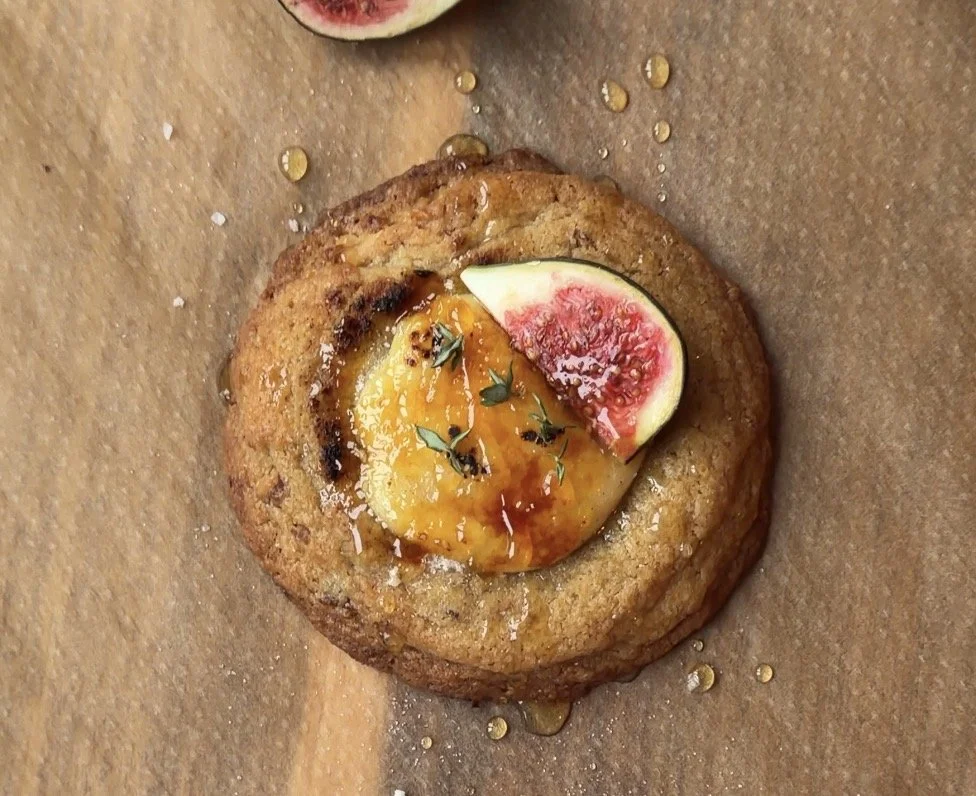
I am the kinda gal who will order dessert but also order a cheeseboard (for the table, of course), and the latter was the inspo for these cookies. Many of the usual suspects make an appearance: ripe Brie melted into a sweet silky crème pat (just trust me), figs - both dried and stirred through the dough, and fresh as a garnish, toasted walnuts and a drizzle of honey. I’ve borrowed the crisp sugar topping from a crème brûlée and made a sweet Brie pastry cream that can be spooned or piped directly onto the cookies.
The cookie itself is made with softened butter (someone alert the press she put DOWN the brown butter for once!), light brown and white sugars, and a little rye flour for its earthy, slightly nutty flavour. Toasted walnuts bring some crunch, while chopped dried figs provide pockets of concentrated sweetness.
The Brie crème pat is deliberately a touch less sweet than a traditional pastry cream, though still plenty sweet enough, allowing the cheese to make itself known. A thin layer of caramelised sugar gives the topping its characteristic crack, and a little fresh thyme finishes everything off.
One for the savoury girls :)
Fig & Walnut Creme Brie-lée Cookies
A buttery fig, walnut and rye cookie, generously studded with dried figs and topped with a silky Brie crème pâtissière. Finished with a crackling layer of caramelised sugar, fresh figs, honey and thyme.
Yield: 12 x 85g cookies
Preparation: 35–45 minutes, including chilling
Cooking: Approximately 12–15 minutes per tray
Oven: 175°C conventional / 160°C fan (starting recommendation)
Difficulty: Intermediate (just the creme pat is a tiny bit fiddly)
Full equipment list at the end of the article.
Ingredients
For the cookies
250g unsalted butter, softened
125g light brown soft sugar
125g granulated sugar
1 large egg, room temperature
5ml vanilla extract
280g plain flour
20g rye flour (can sub for 20g plain flour if you don’t have any!)
½ tsp bicarbonate of soda
½ tsp fine salt
100g walnuts, toasted and roughly chopped
100g dried figs, finely chopped
For the Brie crème pâtissière
120g whole milk
100g Brie, rind removed and chopped into small chunks
2 egg yolks
35g caster sugar
15g cornflour
1tsp vanilla bean paste or extract
Pinch of fine salt
For the brûlée topping and garnish
30g caster sugar
3 fresh figs, quartered
Honey, for drizzling
Fresh thyme leaves (optional)
A Little About Our Ingredients
Unsalted butter: Softened butter is creamed with the sugars, incorporating air into the dough and helping produce a tender cookie. Make sure it’s pliable but not greasy or melting. Butter that’s too warm will encourage excessive spreading. It should ideally be around 18°C to 19°C (65°F to 67°F) - you can check with a probe thermometer.
Light brown sugar: Contains molasses, bringing a little extra moisture, a slightly acidic contribution and gentle caramel notes. It helps give the cookies their chewy texture.
Granulated sugar: Encourages spread and contributes to crispness, particularly around the edges. Using both brown and white sugars gives us a balance of textures.
Egg: Provides water, protein and emulsifiers. It helps bring the dough together and contributes structure as the proteins coagulate during baking.
Plain flour: Forms the structural foundation of our cookies. Its starches and proteins help produce a dough that holds together while still allowing sufficient spread.
Rye flour: Rye has a distinctive earthy, malty flavour that works especially well with walnuts and figs. It also contains less gluten-forming potential than wheat flour, and its pentosans bind water differently, affecting dough consistency and texture. We’re using just 20g here, enough to contribute flavour without dramatically changing the cookie’s structure, but if you would rather leave it out just replace it with plain flour instead.
Bicarbonate of soda: Encourages browning by increasing dough pH and can contribute to leavening where suitable acidic ingredients are present (here we have brown sugar and a tiny bit in eggs). It also influences the texture and spread of the finished cookie.
Walnuts: Toasting develops their flavour making them more aromatic and bringing out their naturally nutty character. Allow them to cool before adding them to the dough.
Dried figs: The concentrated sugars provide sweetness, while their chewy texture contrasts with the cookie. Chop them relatively finely to distribute them evenly.
Brie: The main flavouring ingredient in our pastry cream. Brie contributes fat, protein and a recognisable savoury, dairy flavour. Removing the rind helps achieve a smoother custard. You can of course use top it with a regular pastry cream if the brie turns you off!
Egg yolks: Yolks contribute richness, emulsification and thickening as their proteins coagulate. They work alongside the cornflour to help the custard hold its shape.
Cornflour: Thickens the pastry cream as its starch granules absorb liquid and gelatinise during heating. The relatively generous quantity here is intentional: we want a cream that can support a brûléed sugar topping without running off the cookie.
Caster sugar: Sweetens the custard and forms the thin caramelised crust. Fine, evenly distributed sugar crystals make it easier to achieve a consistent brûlée.
Tips for Making Fig, Walnut & Crème Brie-lée Cookies
1. Toast the walnuts first. Toast them at around 160°C conventional for 8–10 minutes, checking frequently. Cool completely before chopping and adding to the dough.
2. Use softened, not melted, butter. If your butter is excessively warm, the dough may spread too much before it sets in the oven.
3. Don’t overmix the flour. Mix only until the dry ingredients have disappeared. Extended mixing after adding the flour can develop more gluten and produce a tougher cookie.
4. Chill the dough before baking. Chilling helps the butter firm up and makes portioning and handling easier. It may also help moderate spread.
5. Choose your Brie carefully. A ripe Brie will provide a more noticeable flavour than a very mild variety. Remove the rind and cut the cheese into small pieces so it incorporates more easily into the custard.
6. Fully cook the pastry cream. Cornflour needs sufficient heat to gelatinise. Bring the custard to a bubbling thickness, whisking constantly, and cook briefly to eliminate the raw starch flavour.
7. Chill the pastry cream thoroughly. Warm custard will be too soft to support the sugar topping. It needs to be completely cold before assembling.
8. Don’t overload the custard with sugar. A thin, even layer is easier to caramelise without overheating the Brie pastry cream underneath.
9. Garnish after torching. Fresh fig, honey and thyme should be added once you’ve caramelised the sugar. Their moisture will soften the crust if added beforehand.
Method
Part One: Make the Brie Crème Pâtissière
1. Warm the milk.
Pour the whole milk into a small, heavy-bottomed saucepan and place over medium low heat.
Warm gently until steaming, but do not allow it to boil vigorously.
2. Prepare the egg mixture.
Meanwhile, combine the egg yolks, caster sugar, vanilla bean paste, cornflour and salt in a heatproof bowl.
Whisk until completely smooth, making sure no lumps of cornflour remain.
3. Temper the egg yolks.
Slowly pour the warm milk into the egg yolk mixture, a little at a time, whisking continuously.
Adding the milk slowly brings the yolks up to temperature without suddenly coagulating their proteins.
4. Cook the pastry cream.
Return the mixture to the saucepan and place over medium low heat.
Whisk continuously, ensuring you’re reaching the bottom and corners of the pan.
As the mixture heats, the cornflour will begin to gelatinise and the custard will thicken.
Once the custard starts to bubble, continue cooking and whisking for approximately 60 seconds, until thick and smooth. If it looks like its getting too thick you can thin it out by whisking in a little warmed cream or milk until it is the consistency of mayonnaise.
5. Incorporate the Brie.
Remove the saucepan from the heat.
Add the Brie, cut into very small pieces, and stir thoroughly until melted and incorporated.
If necessary, use a stick blender to produce a completely smooth custard. You can also press it through a fine mesh sieve. Avoid incorporating excessive air.
If the cheese doesn’t melt fully, return the saucepan briefly to very low heat while stirring.
6. Chill the pastry cream.
Transfer the finished custard to a clean, shallow container.
Cover directly against the surface to prevent a skin forming and refrigerate promptly until completely cold.
Once chilled, stir briefly to loosen if necessary, then transfer to a piping bag. If you don’t have one you can just spoon it onto the cookies.
Keep refrigerated until ready to assemble.
Part Two: Make the Fig and Walnut Cookies
1. Prepare the walnuts.
Preheat the oven to 160°C conventional / 145°C fan. Spread the walnuts over a baking tray and toast for approximately 8–10 minutes, until fragrant and lightly golden.
Remove from the oven, allow to cool completely, then roughly chop.
2. Cream the butter and sugars.
In a medium bowl, add the softened butter and sugars and whisk until slightly lighter and well combinesd, about 1-2 minutes. You can also do this in stand mixer fitted with the whisk attachment. Scrape down the sides.
3. Add the egg and vanilla.
Add the egg and vanilla extract, then mix until fully incorporated.
Scrape down the bowl again to ensure everything is evenly combined.
4. Combine the dry ingredients.
In a separate bowl, whisk together the plain flour, rye flour, bicarbonate of soda and fine salt.
Add the dry ingredients to the butter mixture and, switching to a rubber spatula, fold until just a few streaks of flour remain.
5. Add the figs and walnuts.
Fold through the chopped dried figs and toasted walnuts, distributing them evenly throughout the dough.
Avoid overmixing.
6. Portion and chill.
Use a 2oz cookie scoop or spoon to divide the dough into 12 spherical portions, weighing 85g each.
Place on a lined tray and refrigerate for 30 mins whilst you preheat the oven to 175°C / 160°C fan.
7. Bake the cookies.
Arrange 3-4 of the chilled dough portions on parchment lined baking trays, leaving a little room for spreading; around 2 inches between each cookie should be enough.
Bake for approximately 12–15 minutes, until the edges are golden brown and set, while the centres remain slightly soft.
The exact baking time will depend on your oven, tray and dough temperature.
8. Shape and cool.
Immediately after removing the cookies from the oven, use a round cutter slightly larger than each cookie to gently nudge them into circles, if needed. Using the back of a spoon, lightly press a shallow indentation into the centre while they’re still warm to create a a little home for our creme pat.
Allow the cookies to cool on their trays for 10 minutes before transferring them to a wire rack to cool completely.
Part Three: Assemble and Brûlée
1. Add the pastry cream.
Make sure the baked cookies have cooled completely.
Pipe or spoon around a tablespoon of the pastry cream onto the centre of each cookie.
2. Add the sugar.
Sprinkle a thin, even layer of caster sugar across the surface of the creme pat.
Use around 1tsp per cookie.
3. Brûlée.
Using a kitchen blowtorch, gently caramelise the sugar, keeping the flame moving constantly.
Work quickly to avoid overheating the custard underneath.
The sugar should melt, bubble and turn an even golden amber.
Allow it to cool and harden into a thin, brittle crust.
5. Garnish and serve.
Place a quarter of a fresh fig onto each cookie.
Finish with a light drizzle of runny honey, a few fresh thyme leaves and a sprinkle of flaky sea salt.
Serve immediately while the caramelised sugar is crisp.
How to Store Your Cookies
Unfilled cookies: They will keep in an airtight container at room temperature for 2–3 days, provided they’re kept somewhere cool and dry. The baked cookies can also be frozen before decorating.
Brie pastry cream: Keep refrigerated at 5°C or below in a clean, covered container. For home preparation, use within 1–2 days as a conservative guideline, although this is not a validated shelf life.
Assembled cookies: Ideally assemble and brûlée immediately before serving. The custard introduces moisture that will gradually soften both the cookie and its caramelised topping.
Can I post these cookies? I wouldn’t recommend posting them in their finished form. The Brie pastry cream is highly perishable and requires temperature control. A safe commercial shelf life and distribution process would need to be established separately.
Frequently Asked Questions
Can I leave the rind on the Brie?
Technically, yes, but I recommend removing it for this recipe.
The rind is edible and contributes some of Brie’s characteristic flavour, but it won’t necessarily melt smoothly into the pastry cream. The mild rind-less flavour lends itself better to these cookies, in my opinion.
Removing it produces a more uniform texture, which is particularly helpful if you’re piping the custard onto the cookies.
What type of Brie should I use?
Choose a good quality Brie with a flavour you enjoy eating.
I personally prefer a very mild Brie just so it’s not too overpowering. A riper Brie provides more pronounced savoury notes so if that’s your vibe, please be my guest!
Why is there rye flour in the cookie dough?
Rye complements the figs and walnuts with its earthy, slightly malty flavour.
At approximately 7% of the total flour weight, its contribution to flavour should be more noticeable than its effect on the overall structure.
If you don’t have rye flour, replace it with the same weight of plain flour.
Can I use fresh figs in the cookie dough instead of dried?
I wouldn’t recommend a direct substitution.
Fresh figs contain considerably more water than dried figs. Adding them would change the dough’s moisture content and potentially affect spread, structure and storage.
Dried figs provide concentrated sweetness and a chewy texture, while fresh figs are better suited to the garnish, in my humble opinion.
Can I make the Brie pastry cream in advance?
Yes. In fact, I’d recommend making it at least a little ahead of time to allow it to cool and set properly.
Keep it covered in the refrigerator, then transfer it to a piping bag shortly before assembling the cookies.
Why has my pastry cream gone lumpy?
Lumps can form if the eggs heat too quickly, the cornflour isn’t fully dispersed, or the custard isn’t whisked consistently during cooking.
If the problem is unmelted Brie, a brief blend may help, or you can pass it through a fine mesh seive.
If the egg proteins have scrambled significantly, blending may improve the appearance but won’t necessarily restore a perfectly smooth texture. In this case it might be best to start again!
Why isn’t my brûlée topping crunchy?
Caramelised sugar is hygroscopic, meaning it absorbs moisture from its surroundings.
Once placed on a moist custard, the brittle caramel will gradually soften.
For the best crack, brûlée your cookies immediately before serving.
Can I make these without a blowtorch?
A blowtorch is strongly recommended, and also LOADS of fun (please be careful)
Placing the assembled cookies under a grill could overheat the pastry cream and soften or burn the cookies before the sugar caramelises evenly, but you can try it, just keep an eye on them!
Love, Rubes xx
Brown Butter Bakes
Equipment You’ll Need
Digital kitchen scales
Large mixing bowl
Medium mixing bowl
Whisk
Silicone spatula
Measuring spoons
Sharp knife and chopping board
Baking trays
Baking parchment
Ice cream scoop or cookie scoop (optional, for portioning)
Round cookie cutter (optional, for shaping)
Small, heavy-bottomed saucepan
Fine-mesh sieve (optional, for smoothing the pastry cream)
Stick blender (optional, for incorporating the Brie)
Piping bag or spoon
Wire cooling rack
Heatproof container for chilling the pastry cream
Kitchen blowtorch